Table of Contents
- Importance of Joining Kitchen Worktops Correctly
- Key Factors That Influence Worktop Joining Techniques
- Professional Worktop Joining Methods Explained
- How to Join Kitchen Worktops? Step-by-Step
- Common Worktop Installation Mistakes
- Tricks to Get Invisible Kitchen Worktop Joints
- Get Seamless Kitchen Worktop Installation UK
- FINAL THOUGHTS - Get Flawless Stone Worktop Joints
- Frequently Asked Questions and Answers
This guide breaks down how should kitchen worktops be joined, the joining methods UK professionals rely on and the common mistakes you’ll want to avoid before signing off on any work.
We have heard so many homeowners horror stories online, some about a gorgeous quartz counter that started swelling around the kettle corner, others about their granite top that never sat level because the fitter rushed the job. The sad truth is that even premium materials like granite, quartz or solid wood will look cheap if the joins aren’t done properly.
Keep reading till the end to get a list of common mistakes homeowners must avoid.
Click Here to See our Recent Installations
Importance of Joining Kitchen Worktops Correctly
In most UK homes, kitchen worktops don’t arrive as one perfect, endless slab especially if you’ve gone for an L-shaped or U-shaped layout to squeeze the most out of a typically awkward British kitchen. That means joints are unavoidable where two pieces meet at corners, long runs, or around sinks and hobs. And while a join might seem like a small detail on installation day, it’s the very thing that decides whether your counters stay beautiful for years or start causing headaches after the first winter. How should kitchen worktops be joined and what do correct joinings get us? These:
1. Prevents Moisture Damage: By stopping water from seeping into small gaps which can cause swelling or mold.
2. Ensures Structural Strength: Proper fixings and adhesives keep surfaces level and stable during heavy use.
3. Creates a Seamless Look: As there are no visible gaps, it gives your kitchen a seamless, perfect look. This apart from being functional also enhances the kitchen’s design and resale value.
BIANCO ANTIQUE GRANITE OFF-CUT

£393.77
Bianco Antico Granite is a white and gray slab with touches of lighter grey, white and brown. … read more
BALTIC BROWN GRANITE

£347.48
Baltic Brown is a coarse-grained granite that has a gorgeous blend of chocolate brown and black with small flecks of light brown. The first look at the granite resembles melted chocolate droplets on a cocoa coloured granite slab.Although it has… read more
BLACK BEAUTY GRANITE

£444.68
Specifications Stone Name: Black Beauty Granite Core material: Granite Nature: Natural Stone Base Colour: Black Pattern: Foam-like white streaks Hardness: 6 on the Mohs scale Uses: Indoor and outdoor Description This Indian granite features a black base surfaced with white… read more
Key Factors That Influence Worktop Joining Techniques
The method used to join kitchen worktops depends on several factors:
1. Material Type
Laminate: Requires precise cutting and sealing to avoid water ingress.
Solid Surface (e.g., Corian): Can be chemically bonded for near-invisible seams.
Quartz or Granite: These worktops are usually joined with colour-matched epoxy and polished for smoothness.
Wood: Needs mechanical fixings plus flexible sealants to accommodate natural expansion.
2. Kitchen Layout
L-shaped corners, breakfast bars, and island connections each require different joining strategies.
3. Thickness and Overhangs
Thicker worktops need stronger biscuits, bolts, or adhesives to ensure stability.
We install all types of stone worktops. Browse Our Latest Collection
Professional Worktop Joining Methods Explained
Here’s how should kitchen worktops be joined professionally:
1. Mason’s Mitre Joint
Often used for laminate worktops, this technique involves cutting two pieces at 45 degrees to create a seamless L-shaped corner.
Pros: Attractive, minimizes visible edges.
Cons: Requires a router jig and skilled installer.
2. Butt Joint
A simpler technique where two straight edges are pushed together and sealed.
Best For: Straight runs or budget-friendly projects.
Key Tip: High-quality sealant is essential to prevent water penetration.
3. Bolt and Biscuit System
Mechanical connectors and biscuits align and hold the pieces while adhesive cures.
Ideal For: Heavy materials like oak or engineered stone.
4. Solid Surface Seamless Join
Used for acrylic or resin-based countertops such as Corian or Hi-Macs. Pieces are glued with colour-matched adhesive and sanded to make the joint virtually invisible.
5. Epoxy and Clamp Method (Stone Worktops)
For quartz, granite and other stone worktops, epoxy and clamp method is used for joining. They are bonded using colour-tinted epoxy while clamps keep surfaces flush until the adhesive sets, after which the joint is polished smooth.
How to Join Kitchen Worktops? Step-by-Step
How should kitchen worktops be joined step by step for a seamless finish? Here’s are the steps:
1. Accurate Measuring and Templating
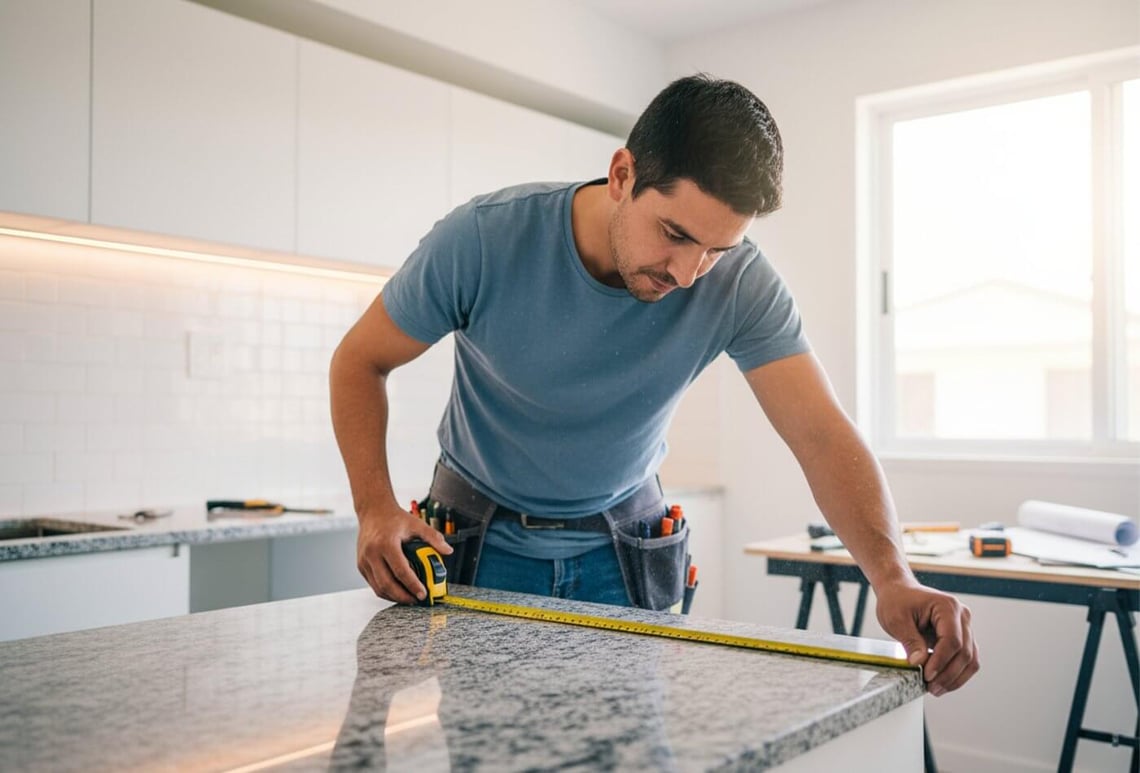
Templating, which means measurement in simple language, is the first step of worktop installation. You need to hire professionals for templating. This ensures that you get precise cuts for your worktop along with any cutouts you need, like sinks and hobs.
2. Edge Preparation
Worktops edges are polished for a clean fit.
3. Dry Fit Test
Installers now position the worktops on top of the cabinet base without adhesive to check alignment.
4. Adhesive Application
Then waterproof sealant or epoxy is applied evenly to prevent gaps.
5. Mechanical Fixing
Worktop bolts or clamps hold the pieces tightly together.
6. Cleaning and Sealing
Professional installers will then wipe off excess adhesive. They’ll then apply a final sealant layer for moisture resistance.
Common Worktop Installation Mistakes
Many of us attempt DIY worktop installations in order to save some money. But without knowing how should kitchen worktops be joined and skipping professional installation leads to more loss than saving in the long run. In most cases if we are not experts, DIY joints result in uneven surfaces or leaks. Why and how does this happen?
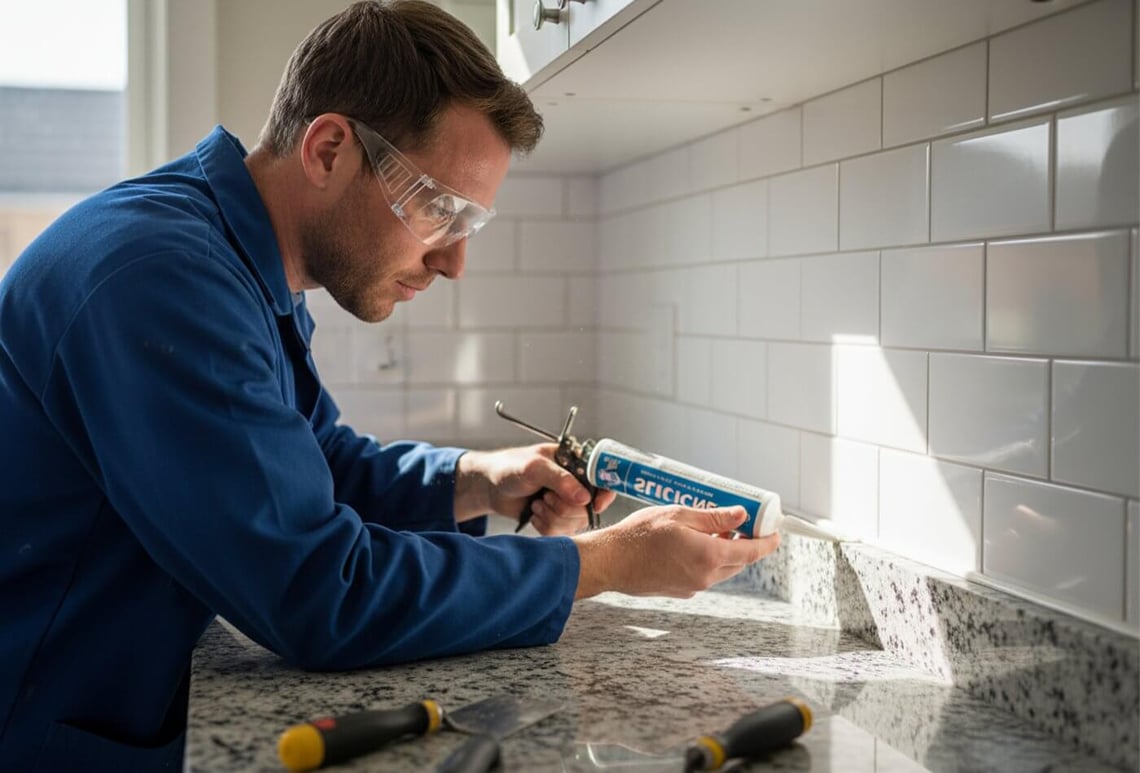
Inadequate Sealant: If you use cheap sealant or insufficient amount, it mostly results in swelling and joint failure.
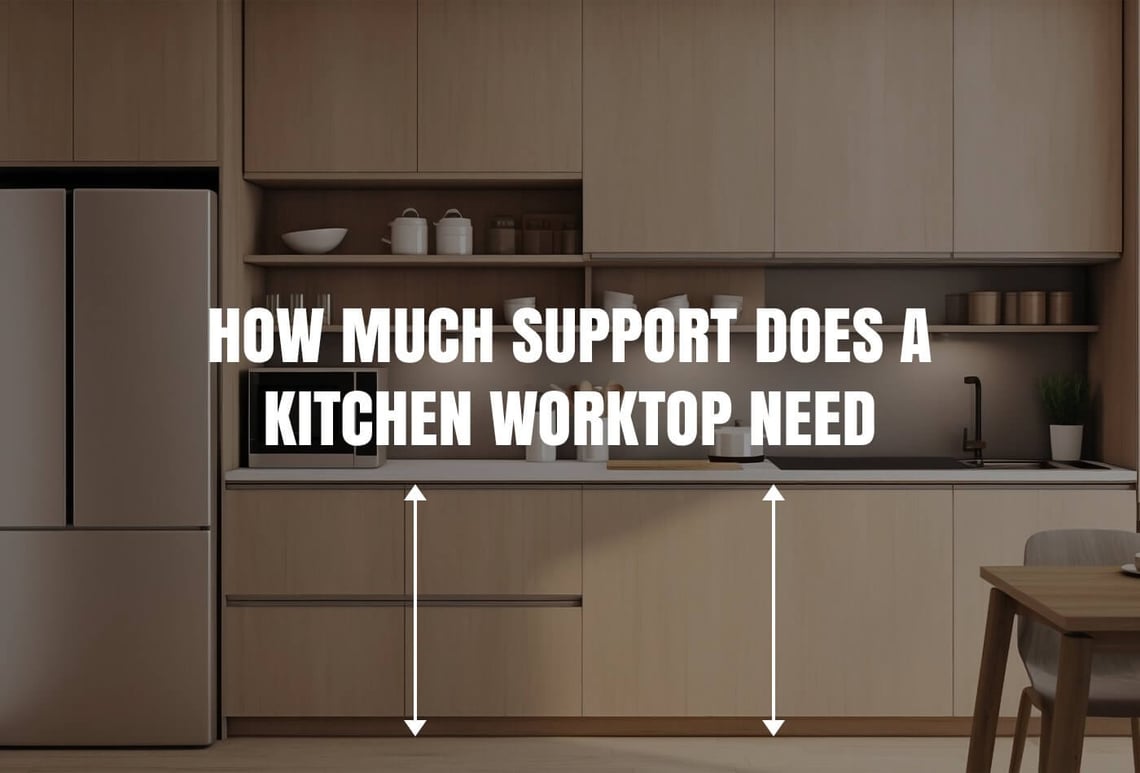
Poor Support: Before installation, you must make sure that your cabinets are durable and can take weight. If there is a lack of proper brackets or base units aren't strong, it will cause sagging over time.
Ignoring Material Movement: If you are installing wooden worktops, you must know that wood is known to expand and contract. So if you don't leave any expansion gap, you will deal with worktop cracks.
Tricks to Get Invisible Kitchen Worktop Joints
These are some easy and simple tricks how should kitchen worktops be joined for a seamless look:
Use Matching Colours: Choose colour-matched adhesives and sealants for stone worktops like granite, marble, quartz, etc.
Strategic Placement: Always hide worktop joints behind your sinks, cooktops and appliance areas.
Opt for Longer Slabs: Try to use bigger stone slabs. If there are fewer joints it means you get a more seamless appearance. However, this may increase the overall cost of your project.
Contact Us for a Seamless Kitchen Makeover
BROWN EMPERADOR DARK MARBLE

£287.00
Brown Emperador Dark Marble's aesthetic qualities make it one of the most sought-after materials on the market. So much so that its use in decoration is so widespread that it is also used to create sculptures. Emperador marble looks great… read more
DAMASTA GREY MARBLE

£309.95
Damasta Grey is one of the most beautiful grey marbles. Its impressive deep grey background, combined with its dispersed creamy white veins, creates an impressive pattern for kitchen islands. This stone is especially good for bathroom design, wall cladding, counter… read more
INDO LAVANTE MARBLE

£260.00
Indo Levanto is a shade of brown-orange marble combined with darker and lighter shades of grey and white veins on the brown-orange slab. This stone is especially good for exterior and interior wall and floor applications, monuments, countertops, mosaics, fountains,… read more
Get Seamless Kitchen Worktop Installation UK

You may choose the best stones for your dream project but if installation is poor, you will end up disappointed. At Work-tops.com, we have installed more than 1000 kitchens in the past few years and our customers have always left with gratitude. We offer expert fabrication and fitting services, ensuring that your chosen granite, quartz,marble surface worktops are joined with precision. Our professional templating, cutting and sealing provides a flawless finish that lasts for years.
Work-tops.com is proud to say that we are consistently rated among the top kitchen worktop suppliers and installers in the UK, with glowing reviews on Trustpilot to back it up.
For smart investment, email info@work-tops.com today or just dial 0330 113 5868. Get stunning slabs and perfect installation, anywhere in the UK.
Next Read: Kitchen Work Triangle Laying Guide
FINAL THOUGHTS - Get Flawless Stone Worktop Joints
As a homeowner, knowing how kitchen worktops should be joined gives us the confidence to make smart choices and avoid costly headaches down the line. We all deserve perfect kitchens, whether we love the timeless elegance of granite, the modern luxury of quartz or the subtle beauty of marble.
Choose only trusted and skilled professionals and choose top-quality materials for a truly seamless finish.
If you still want to know how should kitchen worktops be joined, Call Us Today on 0330 113 5868 to discuss your project or book a free consultation.
Email: info@work-tops.com
Frequently Asked Questions and Answers
How To Waterproof Kitchen Worktop Joints?
Seal your kitchen worktops with waterproof adhesive and clamp tightly to create a moisture-resistant barrier. A tip is to use colour-matched sealant to further protect your joint from spills and steam.
What Is The Best Joint For Seamless Laminate Kitchen Worktops?
A mason’s mitre joint is ideal for laminate because it creates a neat corner with minimal visible edges when sealed correctly.
How To Get Flawless Seams on Granite Worktops?
Yes. Installers use color-matched epoxy and precision polishing to make stone worktop joints nearly invisible.
Do Wooden Worktops Need Special Fixings?
Wood requires mechanical bolts and flexible sealant to accommodate natural expansion and contraction.
How Should Kitchen Worktops Be Joined?
Kitchen worktops should be joined using strong adhesive and colour-matched sealant to create a tight, waterproof seam. Get simple tricks to get seamless joints and avoid common mistakes during installation from this blog.
Is Professional Installation Necessary For Joining Worktops?
Absolutely. Kitchen worktops must be installed by highly experienced professionals not just for looks but to avoid errors that may cause leakages and other problems. Call 0330 1135868 for a discussion.